HELIX Sensor Wrap

Continuous condition
monitoring for critical piping.

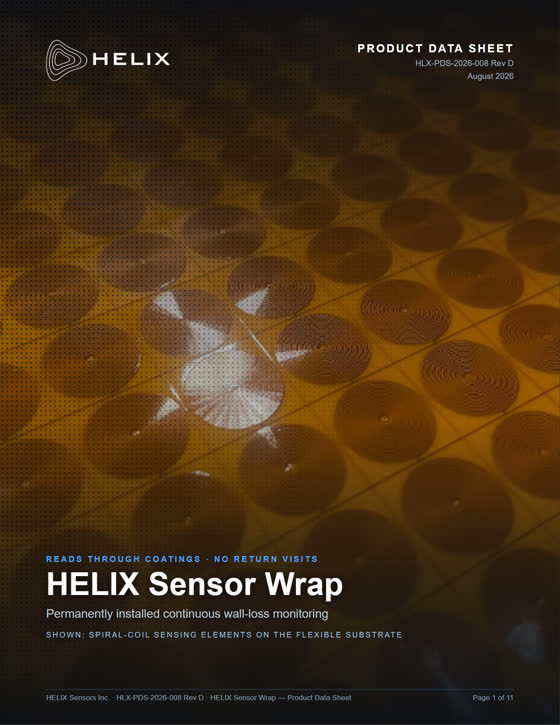
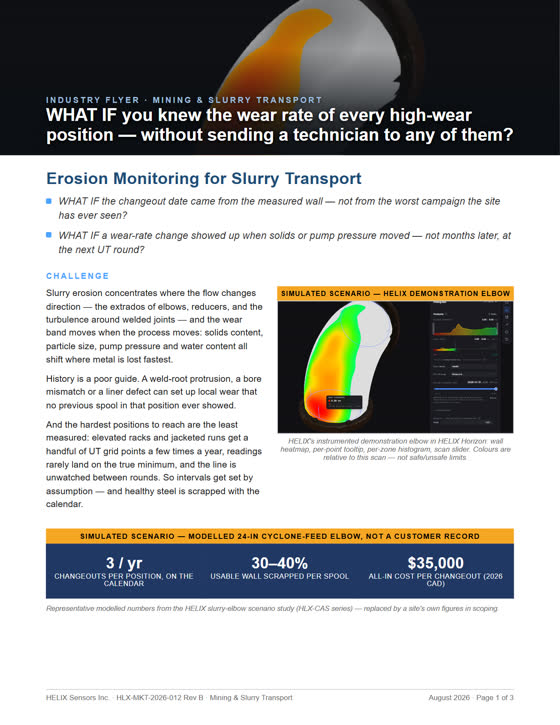
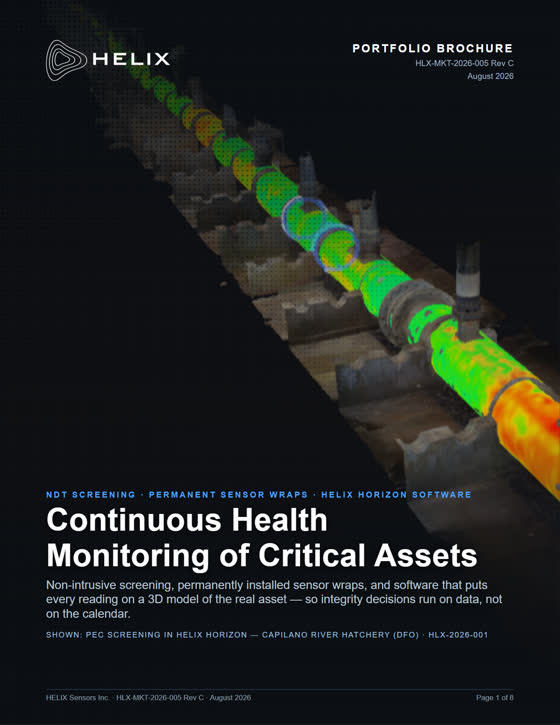
HELIX Sensor Wraps mount permanently to pipes and vessels, mapping corrosion and erosion across the whole monitored surface and tracking how fast it is changing.

Mining · Oil & gas · Pipelines · Pressure vessels
With Helix

Our sensors enable predictive maintenance.

The wrap reads wall thickness continuously. With months of history at every monitored point, we run it forward: where the wall is heading, how fast, and how confident the projection is.

Wall thickness · forecasted

ILLUSTRATIVE · MONITORED POINT P-07 · 6-MONTH PROJECTION

8.68.89.09.29.49.6mm-12 mo-6 motoday+6 moMIN ALLOWABLE 8.85 mm9.19 mmFORECAST →RATE CHANGE

30–40%

Reduction in maintenance cost compared to running to failure

US Department of Energy, on facilities moving off reactive maintenance.

DOE / PNNL, O&M Best Practices

8–12%

Maintenance cost saved again over scheduled preventive maintenance

The gap between maintaining on a calendar and maintaining on measured condition.

DOE / PNNL, O&M Best Practices

The margin the code can make you carry

In some cases API 570 sets thickness-measurement intervals at half the calculated remaining life, subject to the maximum interval for the piping class. Half, because between inspections nobody can see the wall.

API 570, piping inspection code

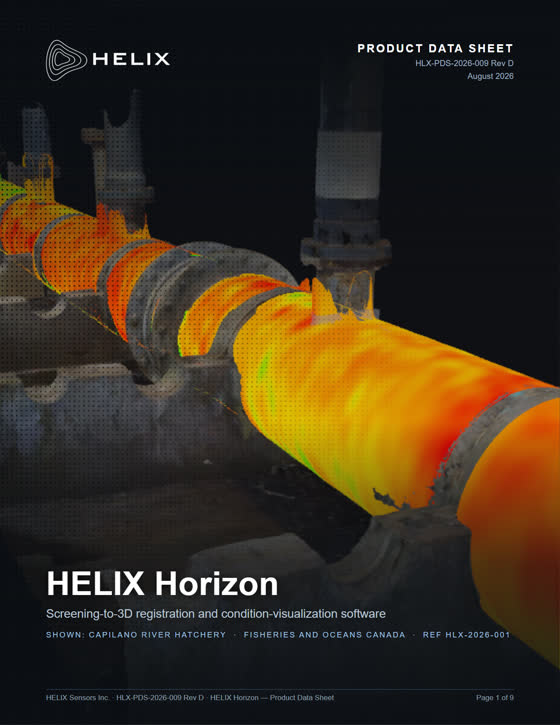
HELIX Horizon software

Watch the demo.

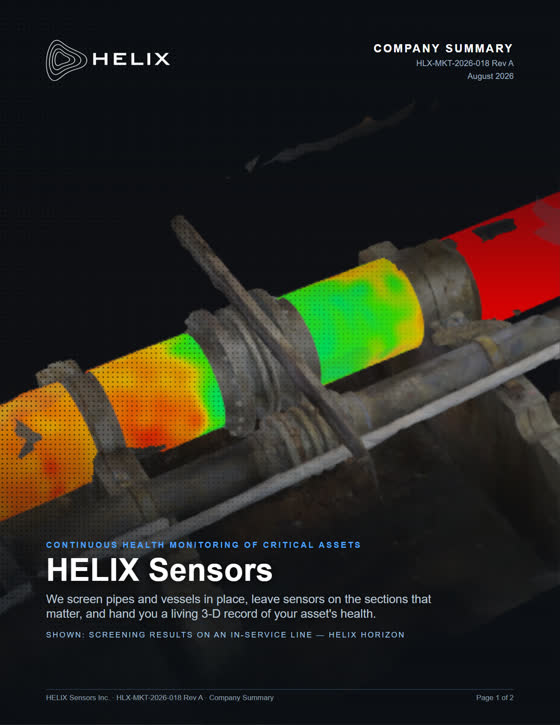
Every reading lands on a 3-D model of your actual asset, at the point it was taken. Not a spreadsheet row, a coloured patch on the pipe, in the room, that an inspector can walk to.

Open the live demo

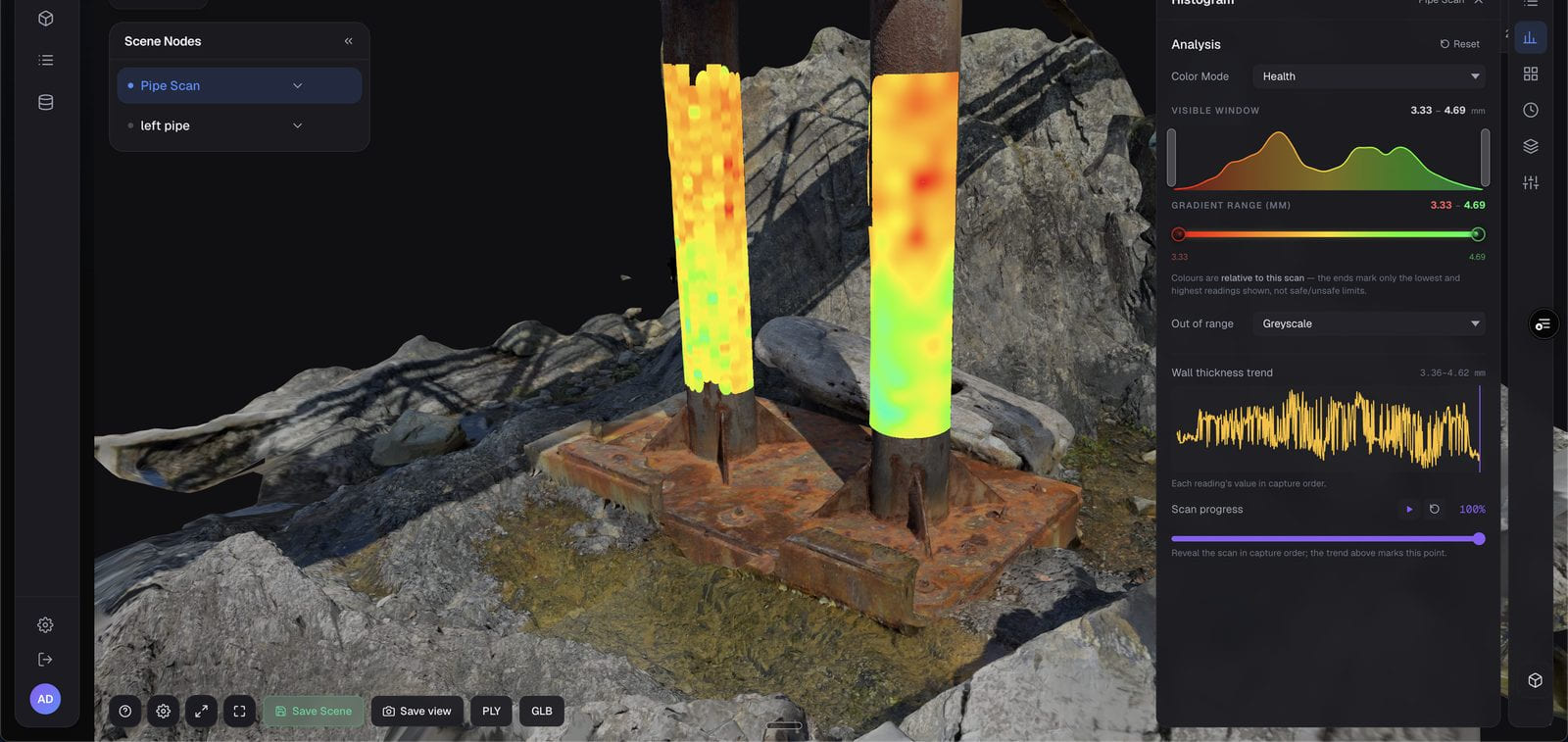
Colours are relative to each scan. They mark the lowest and highest readings shown, not safe or unsafe limits.

0:00 / 0:00

Coverage

Cover surface area, not points.

Our flexible Sensor Wrap measures wall thickness everywhere the wrap covers, so thinning is found where it actually is.

See the live demo

HELIX Horizon with wall thickness mapped across the whole surface of a scanned pipe run, the colour range being swept so different bands of thinning come forward

History

A history for every point on the pipe.

Each scan lands on the same model as the last one. What you get is not a number for today but a rate of change per location, with the evidence behind it.

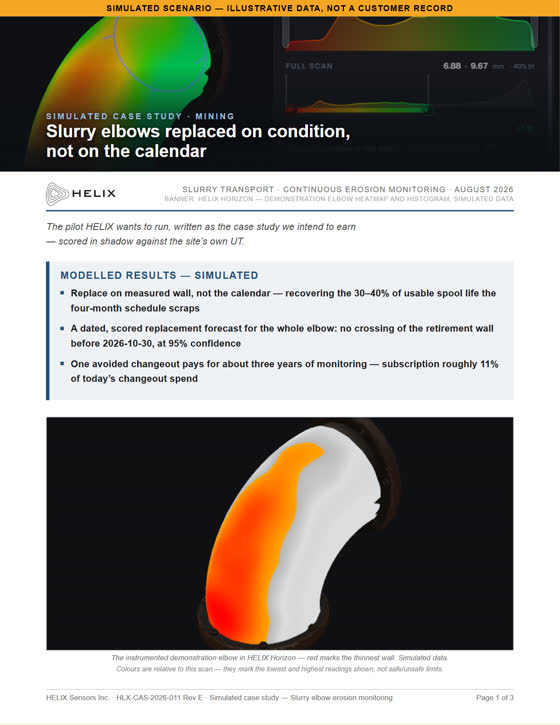
A scanned pipe elbow in HELIX Horizon, with a date slider dragged back and forth so the wall-thickness colouring changes scan by scan

Forecast

Forecast and quantify asset risk.

Run the trend forward against your minimum allowable wall. The answer is a date and a confidence band, which is what a shutdown gets planned around.

Discuss a pilot

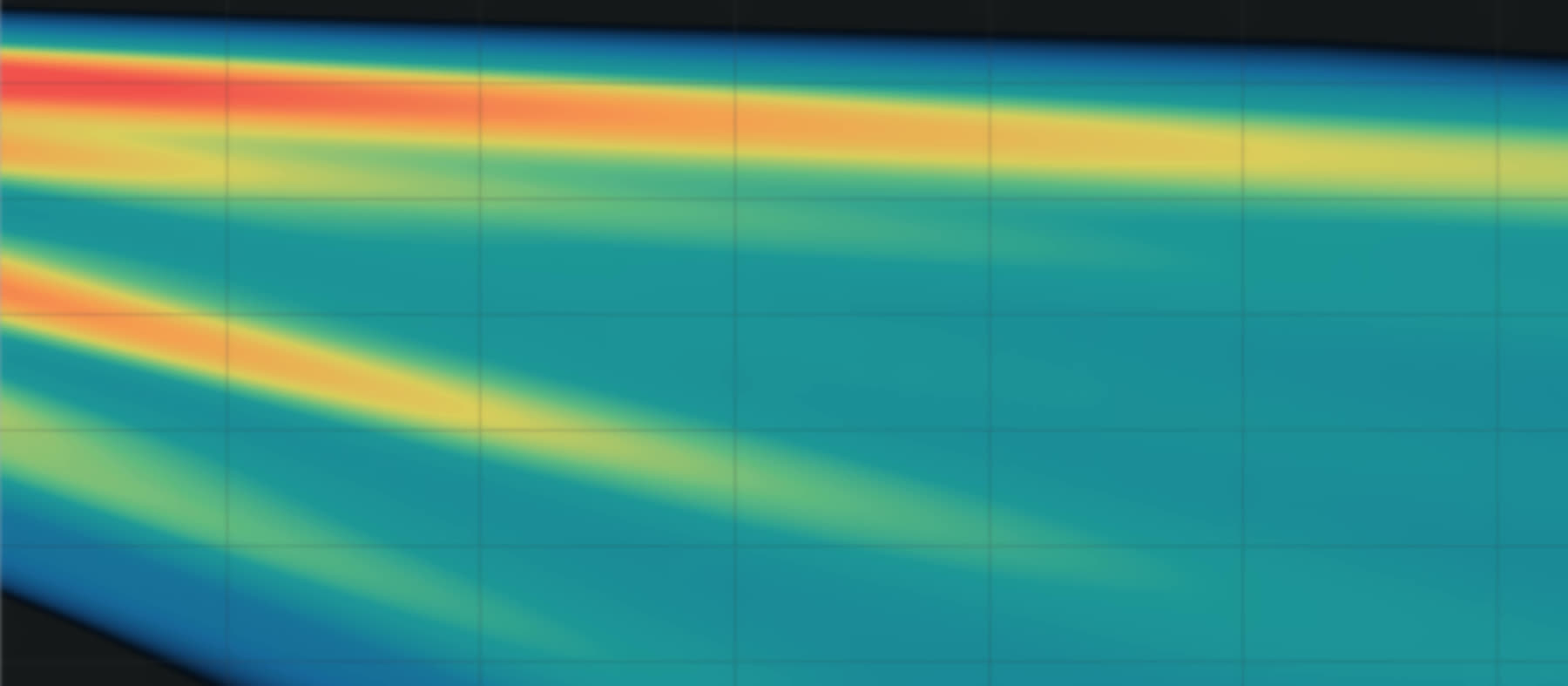
The predicted wall thickness fan in HELIX Horizon, with the time cursor dragged forward and a 3D model of the elbow updating alongside it

Proven in the field

Running on critical assets now.

3,200+

ft² of scanned area

2,000h

Continuous monitoring hours · live

360M+

industrial data points collected

The Helix asset viewer showing two rusted riser pipes with live wall-thickness heat maps, histogram and trend panel.
Live asset viewer · twin risers, wall-thickness field
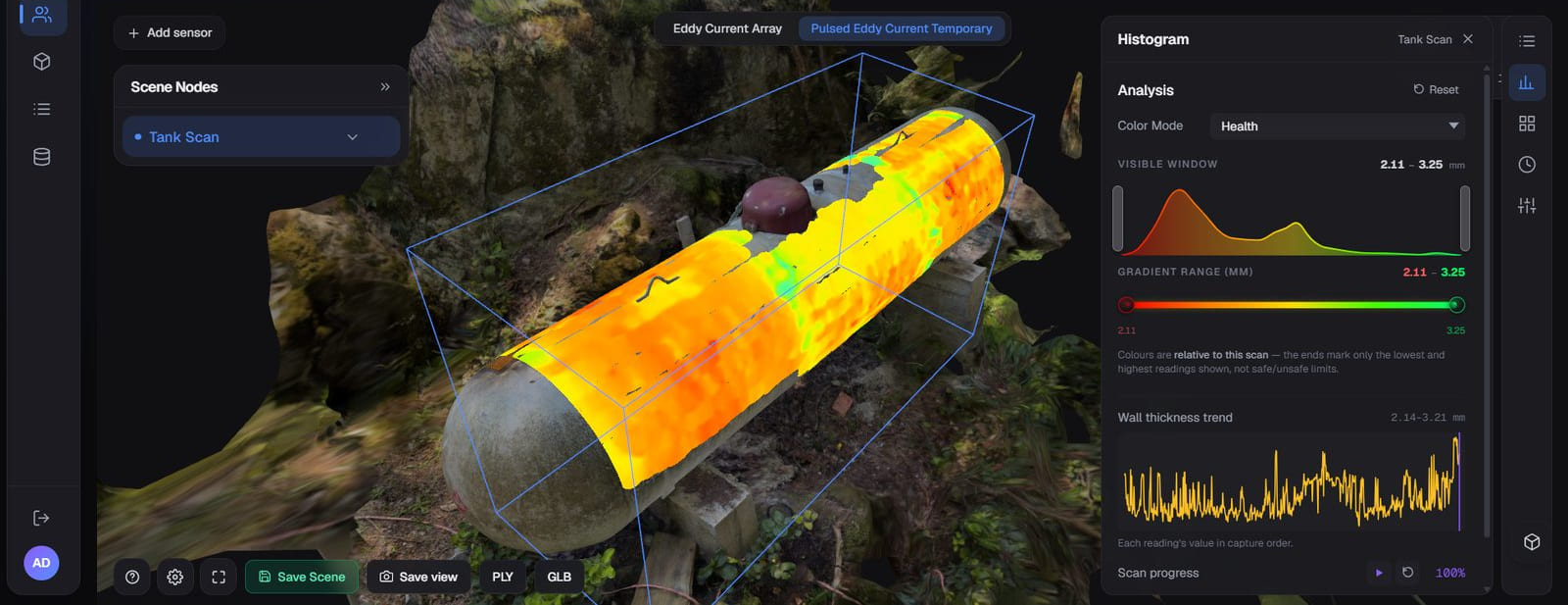
The Helix asset viewer showing a propane tank scan coloured by wall thickness, with eddy-current and pulsed-eddy-current layers.
Propane tank · pulsed eddy current scan
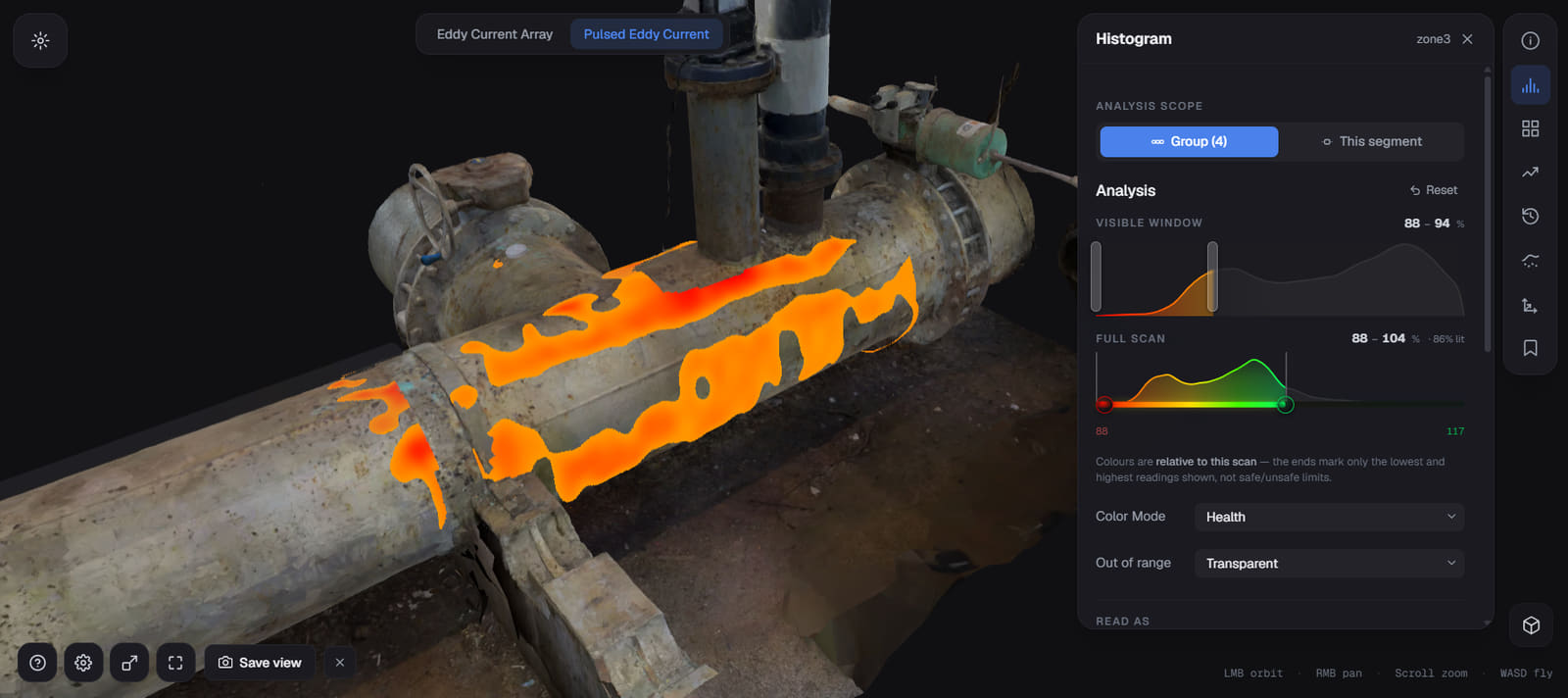
The Helix asset viewer with every reading above 94% wall hidden, leaving an orange band of thinned metal running the length of a scanned spool between two flanges, against a scan range of 88 to 104% wall.
Monitored pipeline · wall loss below 94% of scan
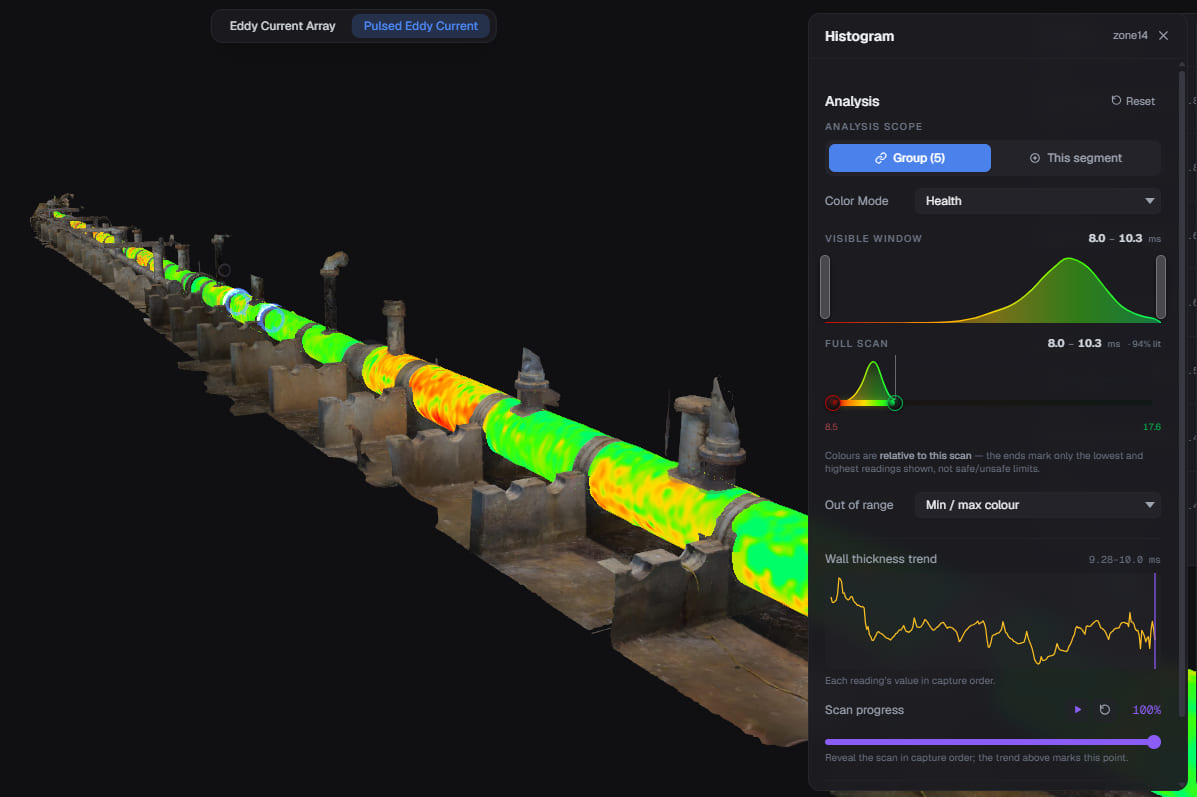
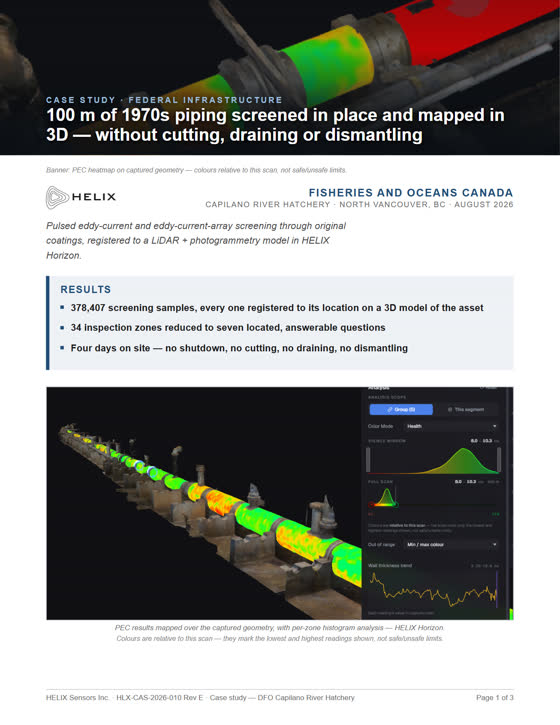
The Helix asset viewer showing a monitored line coloured by pulsed-eddy-current wall thickness over a 8.0 to 10.3 millisecond window, beside the histogram and the wall-thickness trend plotted in capture order.
Monitored pipeline · wall-thickness trend in capture order

Deployed with, and supported by

  • Fisheries and Oceans Canada
  • National Research Council Canada

Proof of value

Proven Impact

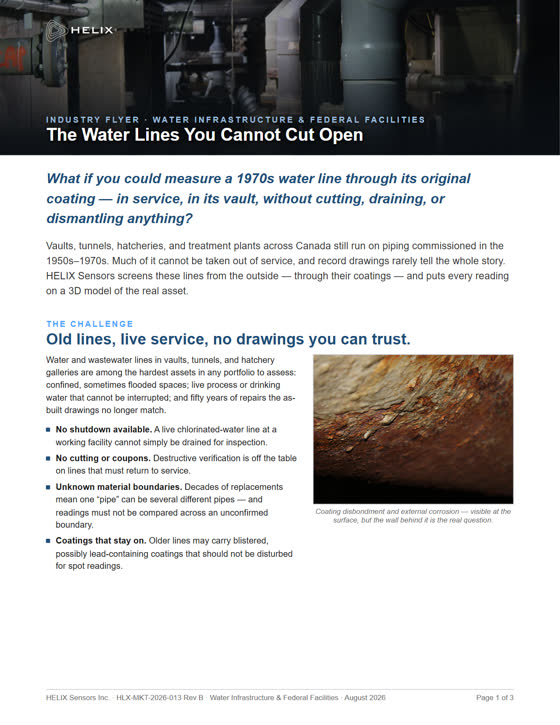
Results from measuring wall thickness continuously, instead of waiting to find out at the next inspection.

$250K

Saved

Estimated new pipeline construction avoided.

12×

Return

Value back against what the assessment cost.

4 days

On site

Screened in place, with the line still in service. Nothing cut, drained or shut down.

How
HELIX
Works

Step 1

We wrap once.

One install, no shutdown, no access work to book again. The wrap goes on and stays on.

Start a pilot

Start with one critical asset.

Put a Sensor Wrap on one location you already inspect, keep inspecting it the way you do now, and compare.

01

Pick one location

An elbow, a spool, or wherever your last inspections found the most wall loss.

02

We install and baseline

The wrap goes on externally. The first full-surface reading becomes your baseline.

03

Run both methods

Keep your normal inspection cycle. When it next runs you have two numbers for the same steel.

04

Decide with data

A measured degradation rate for that location, and a basis for expanding. Or not.

A typical pilot

Locations
1 to 3
Validation period
Defined up front
Install and support
HELIX
Horizon access
Included

Scoped against the asset you have in mind and what its current inspection cycle costs you.

Documents

Case studies, white papers and data sheets.

All documents